
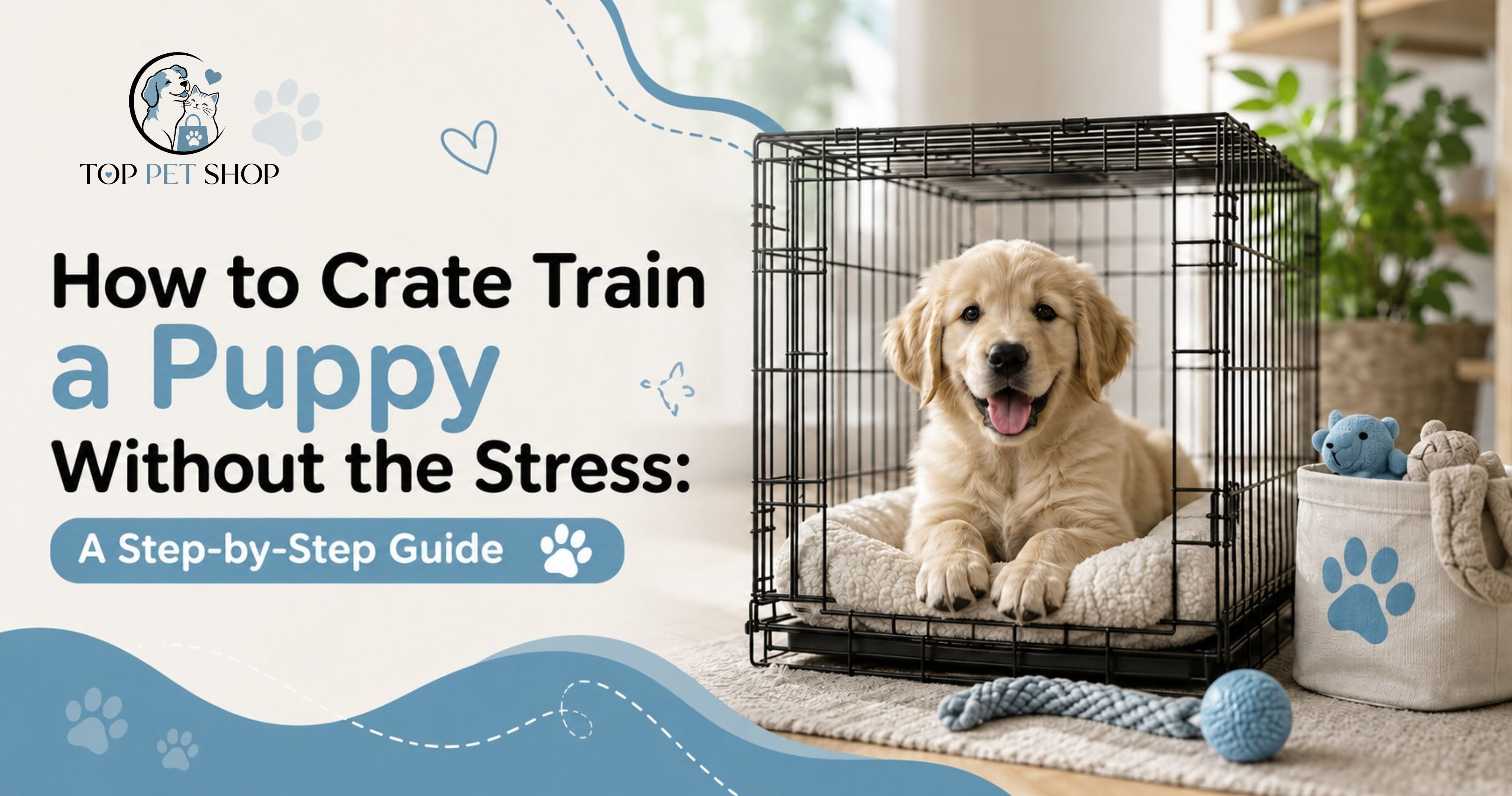
Bringing home a new puppy is filled with endless cuddles, sweet puppy breath, and plenty of excitement. But alongside the fun comes a major responsibility: house training and establishing a routine.
If you are currently struggling with sleepless nights or whining, learning how to crate train a puppy the right way is the single best investment you can make for your peace of mind and your pup’s safety.
Far from being a penalty box, a properly introduced crate acts as a natural den—a safe space where your pup can rest, relax, and retreat when the world gets a little too overwhelming.
In this guide, we break down a stress-free, step-by-step approach to crate training your puppy using positive reinforcement!
Why Crate Training Is Great for Your Puppy
Before diving into the steps, it helps to understand why crates work so well:
-
Taps into Natural Instincts: Dogs are den animals by nature. They naturally desire small, cozy, enclosed spaces to rest.
-
Accelerates Potty Training: Puppies naturally avoid dirtying where they sleep. A crate helps build bladder control.
-
Prevents Destructive Chewing: When you can’t supervise 100% of the time, a crate keeps your pup safe from chewing electrical cords or household items.
-
Simplifies Travel & Vet Visits: A crate-trained dog is far less anxious during car rides, grooming sessions, or emergency stays at the vet.
Step 1: Pick the Right Crate & Set Up a Cozy Den
Success starts with the right gear! Choosing the wrong size or setting up the crate in an isolated area can create unnecessary anxiety.
📐 Size Matters
The crate should be big enough for your puppy to stand up, turn around completely, and lie down comfortably.
💡 Pro-Tip: If you buy a crate sized for your puppy’s adult weight, look for one that includes a divider panel. Adjust the divider as your puppy grows—if the crate is too large, your pup might use one corner as a bedroom and the other as a bathroom!
🏠 Location & Accessories
Place the crate in a lively area of your home, such as the living room or family area, so your puppy doesn't feel isolated.
-
Add a soft, washable pet bed or blanket.
-
Cover three sides of a wire crate with a light sheet or cover to create a true den vibe.
-
Place a few safe, non-toxic chew toys inside to keep them occupied.
Step 2: Introduce the Crate with Positive Associations
Never force your puppy inside or snap the door shut right away. The goal of this step is to make your puppy believe the crate is the coolest place in the house!
-
Leave the Door Wide Open: Let your puppy explore the crate at their own pace.
-
Drop High-Value Treats: Toss favorite treats or kibble near the entrance, then just inside, and finally all the way at the back.
-
Praise Effortlessly: Whenever your pup steps inside to grab a treat, offer soft verbal praise ("Good boy!").
-
Feed Meals Inside: Place your puppy’s food bowl just inside the door. Once they are eating comfortably, move the bowl further back during subsequent meals.
Repeat this process for a couple of days until your puppy walks into the crate voluntarily without hesitation.
Step 3: Practice Closing the Door (Short Intervals)
Once your pup enters happily to eat or hunt for treats, you can begin conditioning them to the door closing.
-
While your puppy is busy eating a meal or chewing on a stuffed treat toy, gently close the crate door.
-
Keep the door closed while they eat, then open it immediately when they finish.
-
Gradually increase the duration:
-
Close the door for 10 seconds, then open and reward.
-
Increase to 30 seconds, then 1 minute, always remaining right next to the crate where they can see you.
-
If your puppy remains calm, you’re ready to start building distance!
Step 4: Add Distance & Build Crate Time
Now it’s time to teach your puppy that being in the crate alone is completely fine and safe.
-
Ask your puppy to enter the crate, give them a reward, and close the door.
-
Sit quietly near the crate for a minute, then step out of the room for 30 seconds before returning.
-
Sit back down quietly for a moment, open the door, and let them out without making a huge fuss.
-
Gradually increase the time you spend out of the room from 2 minutes to 5 minutes, up to 30 minutes.
🐾 Golden Rule: Keep your arrivals and departures low-key! If you get overly excited when opening the crate, your puppy will anxiously anticipate the moment they are released instead of relaxing inside.
Step 5: Overnight Crate Training
Nights can be challenging for young puppies adjusting to separation from their mother and littermates.
-
Keep the Crate Near You at First: Place the crate in your bedroom near your bed for the first week or two. Hearing your breathing and voice will comfort them tremendously.
-
Nighttime Potty Breaks: Young puppies (8 to 12 weeks old) have tiny bladders and typically cannot hold their urine for more than 2 to 4 hours. If your puppy whines in the middle of the night, quietly take them outside for a business-only potty break, then return them directly to the crate with minimal interaction.
How to Handle Whining: Crucial Do's and Don'ts
It’s completely normal for puppies to test boundaries or vocalize when learning new routines. Here’s how to handle it gracefully:
| DO 🟢 | DON'T 🔴 |
| Wait for silence before opening the door (even a 3-second break in whining counts). | Don't let them out while actively crying, or they'll learn crying equals freedom. |
| Provide a distraction, like a safe chew toy or interactive treat dispenser. | Never use the crate as a punishment. It must remain a safe, positive space. |
| Rule out physical needs (potty break, hunger, thirst) before assuming it's demand whining. | Don't leave young puppies crated too long. A general rule: age in months = max hours in crate. |
Happy Crate Training!
With patience, consistency, and plenty of positive reinforcement, your puppy will soon view their crate as their cozy retreat.
Looking for safe chew toys, plush beds, or comforting accessories to make crate training even easier? Explore our full collection of premium, puppy-approved essentials at Top Pet Shop® today!
Share:
Is Your Cat Bored? 7 Signs & How to Keep Them Entertained Indoors